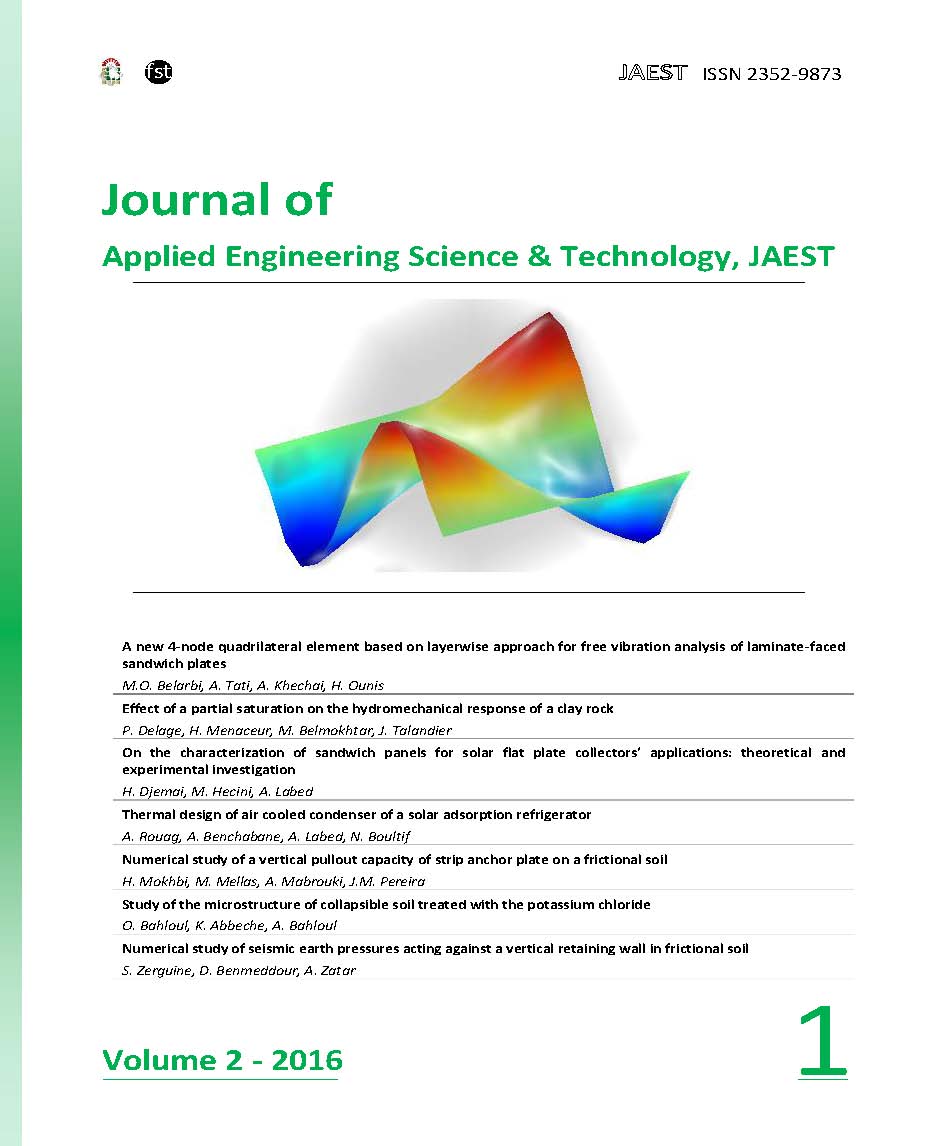
Effect of a partial saturation on the hydromechanical response of a clay rock
 View 256/
 345
345
DOI:
https://doi.org/10.69717/jaest.v2.i1.28Keywords:
Claystone, Desaturation, Suction, Microstructure, SwellingAbstract
The behaviour of claystones and shales ispresently investigated in details in link withtheir potential use as host rock for radioactive waste disposal at great depth. Claystones are verysensitive to changes in water content, with an increase of their mechanical properties withdesaturation under increased suction. Claystones have standard water retention properties butsome effect of hydric damage is observed after a drying-wetting cycle that results in enhancedswelling. The microstructure of the Callovo-Oxfordian claystone tested here is characterized by aclay matrix (50% clay fraction) made up of clay platelets that can be assimilated to bricks. The poresize distribution is well organized around a mean diameter of 32nm that provides an idea of themean thickness of the platelets. A stress release at constant water content results in a swelling anddesaturation due to an internal transfer from free inter-platelets water to linked intra-plateletswater.
Downloads
Downloads
Published
Issue
Section
License

This work is licensed under a Creative Commons Attribution-NonCommercial 4.0 International License.
The Journal of Applied Engineering Science and Technology (JAEST) provides immediate open access to its content on the principle that making research freely available to the public supports a greater global exchange of knowledge.
All articles published in JAEST are licensed under the Creative Commons Attribution 4.0 International License (CC BY 4.0). This license permits users to share, copy, redistribute, adapt, and reproduce the published material in any medium or format, including for commercial purposes, provided that appropriate credit is given to the original author(s) and source, a link to the license is provided, and any changes made are indicated.
Authors retain the copyright of their published work and grant JAEST the right of first publication. Copyright is not transferred to the journal or publisher.
License: Creative Commons Attribution 4.0 International (CC BY 4.0)
License URL: Creative Commons CC BY 4.0