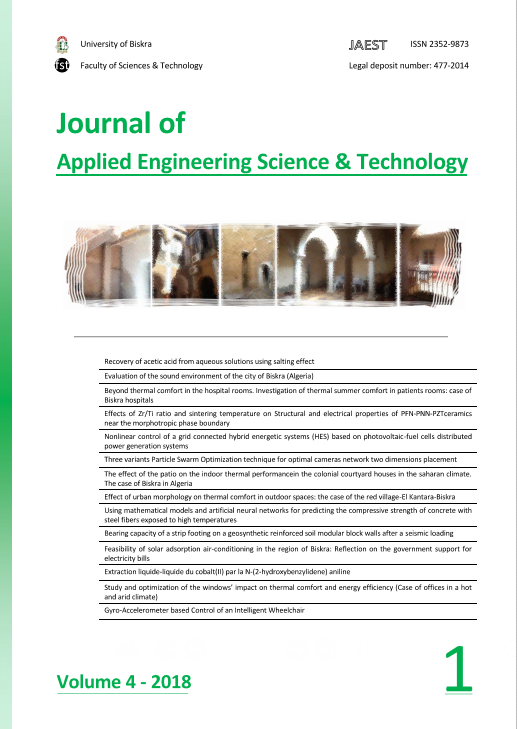
Effects of Zr/Ti ratio and sintering temperature on Structural and electrical properties of PFN-PNN-PZTceramics near the morphotropic phase boundary
 View 659/
 394
394
DOI:
https://doi.org/10.69717/jaest.v4.i1.65Keywords:
PFN-PNN-PZT, Sintering temperature, Morphotropic phase boundary, Piezoelectric, Properties, Dielectric propertiesAbstract
0.05Pb[Fe1/2 Nb1/2]O3-0.05Pb[Ni1/3Nb2/3]O3-0.90Pb[ZrxTi(1-x)]O3 [PFN-PNN-PZT] quaternary piezoelectric ceramics with varying Zr/Ti ratios located near the morphotropic phase boundary (MPB) were prepared by a conventional mixed-oxide route. The samples structure was determined by X-ray diffractometry which indicate that the phase structure, of sintered PFN-PNN-PZT ceramics, was transformed from tetragonal to rhombohedral with Zr/Ti ratio increased in system. The effect of Zr/Ti ratio and sintering temperature on the structure and piezoelectric properties of our simples were investigated. The new MPB in this quaternary system with optimum piezoelectric properties was found at x = 0.51-0.53. The dependence of the piezoelectric coefficient (d31), electromechanical coupling factor (kp) and the dielectric constant (ε) on the Zr/Ti ratio shows a pronounced maximum of d31 = 141* 10-12 C/N, kp= 0.64 and ε = 850 at Zr/Ti : 51/49. As the Zr/Ti ratio increases, the Tcof PFN-PNN-PZT ceramics decreases and consequently the peak in the dielectric spectrum corresponding to the Tc moves towards room temperature. A Tc of 360 °C is obtained when Zr/Ti: 51/49.
Downloads
Downloads
Published
Issue
Section
License

This work is licensed under a Creative Commons Attribution-NonCommercial 4.0 International License.
The Journal of Applied Engineering Science and Technology (JAEST) provides immediate open access to its content on the principle that making research freely available to the public supports a greater global exchange of knowledge.
All articles published in JAEST are licensed under the Creative Commons Attribution 4.0 International License (CC BY 4.0). This license permits users to share, copy, redistribute, adapt, and reproduce the published material in any medium or format, including for commercial purposes, provided that appropriate credit is given to the original author(s) and source, a link to the license is provided, and any changes made are indicated.
Authors retain the copyright of their published work and grant JAEST the right of first publication. Copyright is not transferred to the journal or publisher.
License: Creative Commons Attribution 4.0 International (CC BY 4.0)
License URL: Creative Commons CC BY 4.0