Shear Deformations of FGM Beams with Mixed Restraints under Bending Using HSD Theory
 View 418/
 0
192
0
192
DOI:
https://doi.org/10.69717/jaest.v6.i1.145Keywords:
FGM beams, Mixed boundary conditions, Bending, HSD Theory, Displacement , Shear StressAbstract
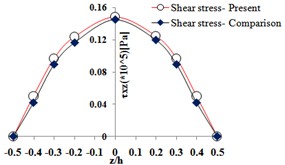
This paper presents a new proposed mathematical model for functionally graded material (FGM) beams with mixed restraints. Higher order shear deformation theory (HSDT) is used for FGM prismatic beams under bending taking into account the shear strains in the displacement field. A novel polynomial shear function is utilized for the shear stress which implies the nullity at the both top and bottom fibers faces of the cross-section, and its maximal value at the midline fiber. Material Characteristics are assumed to be varied continuously through the total thickness following a simple power-law, according to the volume fractions between constituents. The virtual work principle is employed for deriving the governing equations of the beam solved analytically using the integrals to obtain the displacement and the constitutive stress-strain relations with efficacy deterministic manner. It is noted that the material of FGM beam obeys Hooke’s law. The equilibrium equations and boundary conditions are considered in this study. Furthermore, the novel analytical model is explored using two illustrative examples. The obtained results predicted from the new proposed model for clamped-simply supported (C-S) beams under bending, are in good agreement with those obtained from the available literature.
Highlights
- New HSDT model for FGM beams with mixed boundary conditions.
- Novel polynomial shear function ensures zero stress at beam surfaces.
- Analytical solutions derived using virtual work principle.
- Results show strong agreement with existing models (≤3‰ error).
- Model accurately predicts displacement and shear stress behavior.
Downloads
Published
Issue
Section
License
Copyright (c) 2026 Journal of Applied Engineering Science and Technology

This work is licensed under a Creative Commons Attribution 4.0 International License.
The Journal of Applied Engineering Science and Technology (JAEST) provides immediate open access to its content on the principle that making research freely available to the public supports a greater global exchange of knowledge.
All articles published in JAEST are licensed under the Creative Commons Attribution 4.0 International License (CC BY 4.0). This license permits users to share, copy, redistribute, adapt, and reproduce the published material in any medium or format, including for commercial purposes, provided that appropriate credit is given to the original author(s) and source, a link to the license is provided, and any changes made are indicated.
Authors retain the copyright of their published work and grant JAEST the right of first publication. Copyright is not transferred to the journal or publisher.
License: Creative Commons Attribution 4.0 International (CC BY 4.0)
License URL: Creative Commons CC BY 4.0