Author Guidelines
Submission Process
Authors should prepare their manuscripts in clear and grammatically correct English, using either British or American English consistently throughout the manuscript. Submissions must represent original work that has not been previously published and is not currently under consideration by another journal.
Manuscripts should be prepared using Microsoft Word and should include all relevant text, tables, figure captions, and other manuscript elements.
For assistance with the online submission system, please contact the Editor-in-Chief at: jaest@univ-biskra.dz.
Registration and Login
Authors must first register and log in to the journal's online submission system. Manuscripts should be submitted through the following link:
Manuscript Upload
Submit the manuscript as a single Microsoft Word document. Figures and tables should be inserted at the appropriate locations within the manuscript. Any supplementary material should be clearly identified and uploaded during the submission process where appropriate.
Peer Review
All manuscripts submitted to JAEST are evaluated according to the journal's editorial and peer-review procedures. Manuscripts are assessed for scientific quality, originality, relevance, technical soundness, clarity, and contribution to the field.
Revision
Authors may be requested to revise their manuscript in response to comments from editors and reviewers. Revised manuscripts should be accompanied, when requested, by a detailed response explaining how each comment has been addressed.
Acceptance
A manuscript is accepted for publication only after completion of the peer-review process and final approval by the editorial team. Acceptance is based on the scientific quality of the manuscript and its compliance with the journal's requirements.
Proofs
Proofs will be sent to the corresponding author before publication and should normally be checked and returned within 3 days of receipt. At the proof stage, corrections should generally be limited to typesetting errors, formatting issues, and minor necessary corrections. Major changes to the scientific content are not normally permitted at this stage.
Online Publication
Following completion of the proof-correction process, the final version of the article will be prepared for publication. Published articles will be made openly accessible online and will receive their relevant bibliographic information and DOI, where applicable, enabling them to be searched, accessed, cited, and shared.
Copyright and Licensing
Authors retain the copyright of their published work and grant the Journal of Applied Engineering Sciences and Technology (JAEST) the right of first publication.
All articles published by JAEST are licensed under the Creative Commons Attribution 4.0 International License (CC BY 4.0). This license permits users to share, copy, redistribute, adapt, transform, and build upon the published material for any purpose, including commercial purposes, provided that appropriate credit is given to the original author(s) and source, a link to the license is provided, and any changes made are indicated.
Copyright is not transferred from the authors to the journal or publisher. By submitting a manuscript, the authors confirm that the work is original, has not been previously published, is not under consideration by another journal, and that all authors have approved the manuscript and agree to its submission to JAEST.
Types of Paper
JAEST publishes full-length research articles, short communications, and review papers.
Full-Length Research Articles
Full-length research articles report original and substantial scientific work. They should present clearly defined objectives, appropriate methodology, reliable results, and a meaningful discussion of the significance of the findings.
A typical research article should include: Abstract, Keywords, Introduction, Materials and Methods, Results, Discussion, Conclusion, Acknowledgements, Declaration of Competing Interest, and References, where applicable.
Short Communications
Short communications report significant, original, and timely findings in a concise format. They should provide sufficient scientific information to allow readers to understand the methodology, results, and importance of the work while remaining shorter than a full-length research article.
Review Papers
Review papers provide comprehensive and critical analyses of recent developments in a specific research area. They should summarize the current state of knowledge, evaluate major advances, identify unresolved questions or research gaps, and discuss future research directions.
Manuscript Preparation
Formatting
Manuscripts should be prepared in a clear and readable format using a standard font such as Times New Roman, 12 pt. Authors are encouraged to use adequate line spacing, continuous line numbering, and sufficient margins to facilitate the editorial and peer-review process.
Title Page
The title page should include the following information:
- Title of the manuscript.
- Full names of all authors.
- Complete institutional affiliations.
- Name and email address of the corresponding author.
- Highlights.
- Graphical abstract.
- A concise and informative abstract of approximately 150–250 words.
- Keywords.
Figures and Tables
Figures and tables should be inserted at appropriate locations within the manuscript and should be cited in numerical order in the text. All figures and tables must be clear, legible, properly captioned, and of sufficient quality for publication.
References
References should follow the JAEST reference style. Authors are responsible for ensuring that all references are complete, accurate, consistently formatted, and properly cited in the manuscript.
Article Structure
Title
The title should be concise, informative, and accurately reflect the main subject and contribution of the study.
Authors
Provide the full names and institutional affiliations of all authors, including department, institution or organization, city, and country.
Corresponding Author
Clearly identify the author responsible for correspondence during submission, peer review, publication, and post-publication communication. A valid email address must be provided.
Abstract
The abstract should normally contain between 150 and 250 words. It should provide a concise summary of the purpose, methodology, principal results, and main conclusions of the study. The abstract should be understandable on its own and should generally avoid references, footnotes, and undefined abbreviations.
Keywords
Provide 3 to 7 keywords or short phrases that accurately represent the main topics of the manuscript and facilitate indexing and discoverability.
Introduction
The introduction should provide sufficient background to place the study in context, identify the scientific or technical problem addressed, discuss relevant previous work, highlight the research gap, and clearly state the objectives or hypotheses of the study.
The introduction should generally address:
- Background and context of the research topic.
- Relevant and recent scientific literature.
- The research problem or knowledge gap.
- The objectives, hypotheses, or main purpose of the study.
Materials and Methods
This section should provide sufficient detail about the experimental, numerical, theoretical, or analytical procedures to enable other researchers to understand and, where appropriate, reproduce the work.
Results
Results should be presented clearly and logically. Tables, figures, graphs, and other visual elements may be used when they improve understanding of the data. Unnecessary duplication of the same information in both text and figures or tables should be avoided.
Discussion
The discussion should interpret the principal findings, explain their scientific or practical significance, compare them with relevant previous studies, address possible limitations, and discuss potential implications and future research directions.
Conclusion
The conclusion should clearly summarize the principal findings and contributions of the study without unnecessarily repeating the abstract, introduction, or discussion.
Acknowledgements
Authors should acknowledge individuals, institutions, laboratories, organizations, or funding bodies that contributed to the work but do not meet the criteria for authorship.
Declaration of Competing Interest
Authors must disclose any financial, professional, institutional, or personal relationships that could be perceived as influencing the work. If no competing interests exist, authors should include an appropriate declaration stating this.
Units
Authors should follow internationally accepted conventions and use the International System of Units (SI). If non-SI units are necessary, their SI equivalents should be provided where appropriate.
Mathematical Formulae
Mathematical expressions and equations should be submitted as editable text rather than images. Variables should normally be presented in italics. Simple fractional terms may be written using a solidus (/), where appropriate. Equations displayed separately from the text and referred to in the manuscript should be numbered consecutively.
Figures and Tables
Tables
Tables should be numbered consecutively using Arabic numerals and placed within the main text near their first citation. Each table must be cited in the manuscript and should have a concise, descriptive title positioned above the table.
Tables must be submitted as editable text rather than as images. Authors should avoid unnecessary duplication of information already presented in figures or in the main text.
Figures
Figures should be numbered consecutively and inserted at appropriate locations in the manuscript. Photographs, diagrams, graphs, schematics, and other illustrations should be clear and of publication quality.
Figures should preferably have a resolution of at least 300 dpi. Text, symbols, legends, and labels must remain legible when the figure is displayed at publication size.
References
All sources cited in the manuscript must appear in the reference list, and all references included in the reference list must be cited in the manuscript.
References should be cited in the text using numbers enclosed in square brackets, for example: [1], [1,2], or [1–3]. References should be listed in numerical order according to their first appearance in the manuscript.
Authors should carefully verify author names, article titles, journal titles, publication years, volume and issue numbers, page ranges or article numbers, and DOI information before submission.
Reference Style
Journal article:
[1] M.H. Fernandes, B. Ramos, A.L. da Silva, D. Gouvêa, Chloride-doped ZnO thin films prepared by spray pyrolysis: Effects on microstructural, optical, and photocatalytic properties, Micro and Nanostructures 177 (2023) 207550. https://doi.org/10.1016/j.micrna.2023.207550 .
Journal article with an article number:
[2] A. Jerrentrup, T. Mueller, U. Glowalla, M. Herder, N. Henrichs, A. Neubauer, J.R. Schaefer, Teaching medicine with the help of “Dr. House”, PLoS ONE 13 (2018) e0193972. https://doi.org/10.1371/journal.pone.0193972 .
Book:
[3] R.C. Weast, CRC Handbook of Chemistry and Physics: A Ready-Reference Book of Chemical and Physical Data, CRC Press, 1975.
Website:
[4] World Bank, Climate Change Knowledge Portal: Climatology for Algeria, 1991–2020. https://climateknowledgeportal.worldbank.org/country/algeria/climate-data-historical (accessed 06 March 2024).
Graphical Abstract
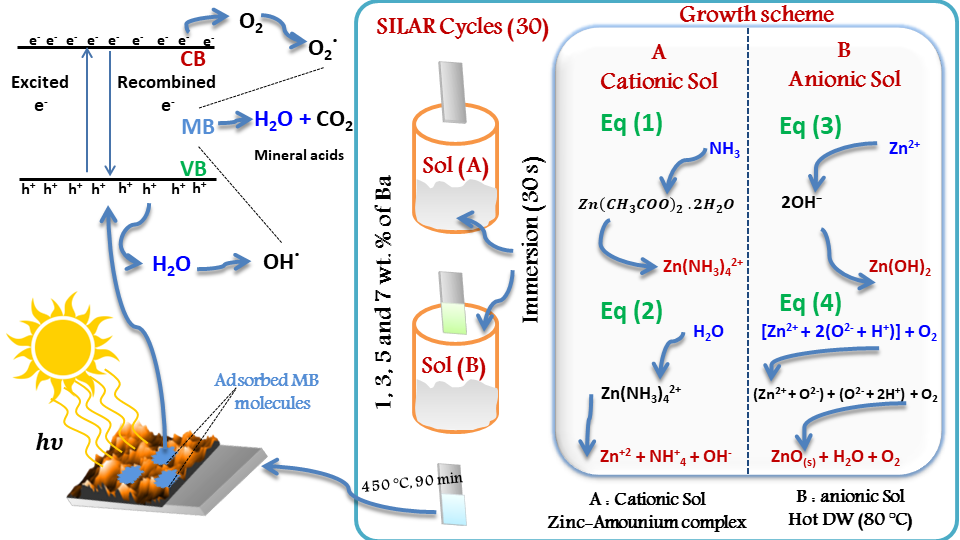
A graphical abstract is a concise visual representation of the principal content, methodology, or findings of the manuscript. It should allow readers to understand the central concept of the study quickly and should encourage further exploration of the full article.
The graphical abstract should use clear graphics, diagrams, flowcharts, illustrations, or key experimental results. Authors should minimize lengthy text and use concise labels or short captions where necessary.
A representative figure from the manuscript may also be used as the graphical abstract if it clearly summarizes the principal contribution of the study.
Example:
The example graphical abstract illustrates the photocatalytic degradation of methylene blue (MB) using ZnO thin films and presents the principal stages of the preparation and photocatalytic process.
- Growth scheme of the ZnO thin films.
- Photocatalytic degradation process.
Highlights
Highlights are short bullet-point statements summarizing the principal findings, novelty, methodology, and significance of the manuscript.
Authors should provide 3 to 5 highlights. Each highlight should be concise and should not exceed approximately 90 characters, including spaces.
Example:
- Increased film thickness enhances methylene blue degradation under sunlight.
- ZnO films show band-gap expansion from 3.15 eV to 3.31 eV.
- SILAR produces ZnO nanorods with an increased active surface area.
- Film resistivity increases with thickness, indicating tunable properties.
- Thicker ZnO films exhibit increased preferential (100) orientation.